
Hangzhou Gaoke Industry&trade Co., Ltd.
Time:2026-03-10 Click:1660 seen
In smart classrooms, collaborative meeting spaces, and commercial display environments, touch technology is central to interactive experiences. Among the many solutions available today, infrared touch and capacitive touch are two of the most widely used technologies. Understanding their working principles and differences in practical applications helps schools and businesses choose the most suitable interactive display solution.
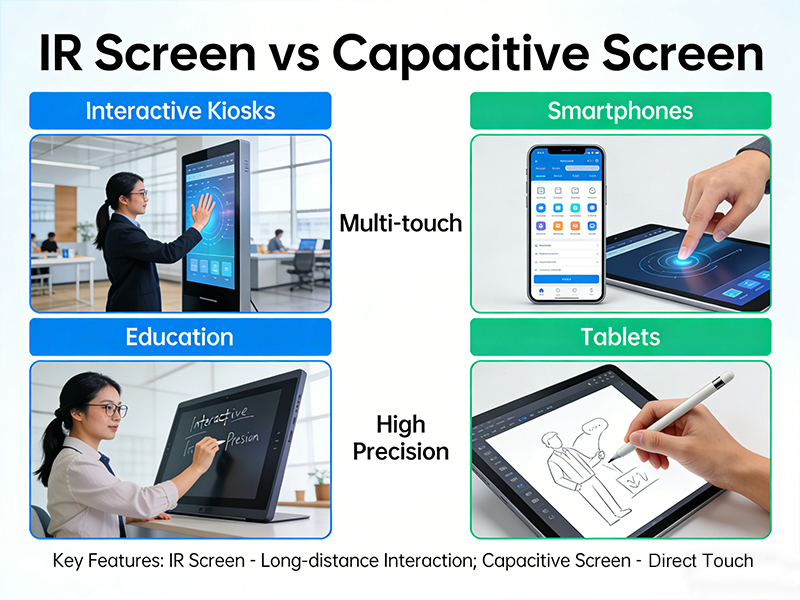
Infrared touch technology is based on optical positioning principles. Infrared emitters and receivers are arranged along the edge of the display screen, forming an invisible grid of beams on the screen surface. When a finger, stylus, or other object touches the screen, it blocks a specific infrared beam. The system detects the blocked signal and calculates the precise touch location. Because this technology does not rely on conductivity, it can recognize input from fingers, gloves, styluses, and even non-conductive objects. Its independent frame structure also makes it easier to implement on large-size displays, offering high stability and relatively low maintenance costs. Therefore, infrared touch technology is widely used in educational interactive flat panel displays and large conference displays.
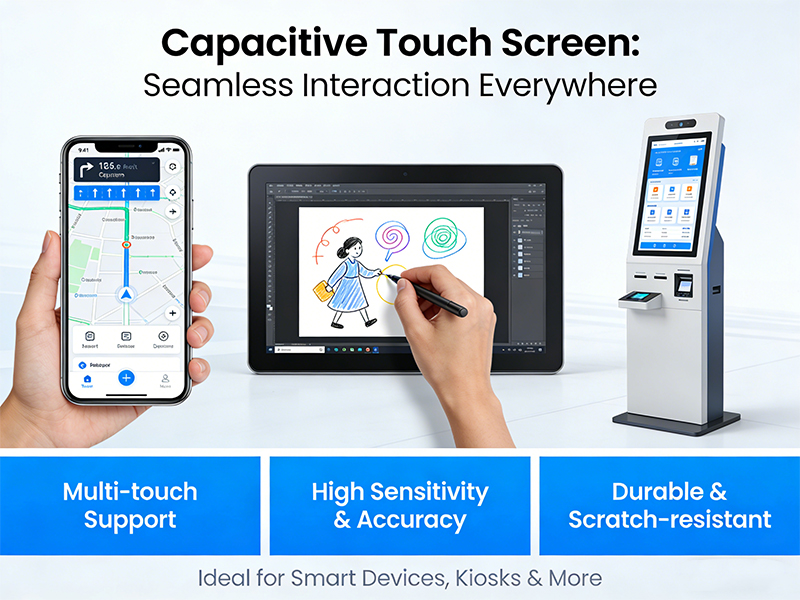
On the other hand, capacitive touch technology is based on the conductivity of the human body. A transparent conductive layer on the screen surface generates a stable electrostatic field. When a finger touches the screen, it changes the local capacitance, allowing the system to detect the touch location. Capacitive touch offers advantages such as fast response, high precision, and smooth operation, making it widely used in smartphones and tablets. Its strengths lie in its sensitive touch response and accurate gesture recognition, but it typically requires conductive input and may respond poorly to non-conductive objects.
From a practical application perspective, these two technologies differ in several key aspects. Infrared touch is particularly suitable for large screens and multi-user interaction environments. It supports high multi-touch capability, is compatible with various input methods, and boasts excellent durability, capable of withstanding high-frequency use. Capacitive touch excels in precision and response speed, making it ideal for small devices requiring fine control and complex interactions. In scenarios such as education and meetings where continuous use of large screens is necessary, infrared touch typically offers better overall stability and flexibility.
Environmental adaptability is also a factor to consider. Infrared touch systems require clearly defined boundary areas and are susceptible to dust or edge obstruction. Capacitive touch has lower sensitivity to ambient light but may not function properly when users wear gloves or use non-conductive tools. Therefore, choosing the appropriate technology should consider usage conditions, maintenance requirements, and interaction needs.
With the continuous development of smart education and digital collaboration, touch technology is also constantly advancing. Improvements in infrared detection algorithms, lower latency processing, and more sophisticated integrated system design are all enhancing writing accuracy and interactive smoothness on large-screen displays.
As a professional commercial display solutions provider, Hangzhou Gaoke Industry & Trade Co., Ltd. integrates reliable and mature touch technology into its interactive display products, helping schools and enterprises achieve efficient and reliable collaborative experiences.

Hangzhou Gaoke Industry&trade Co., Ltd.


+8613706719639


A6 Cainiao Zhigu, Yuhang District, Hangzhou, Zhejiang, China




 中文
中文 English
 +86(571)89986945
 +8613706719639
 +8613706719639
 service@hz-gaoke.com
